
Default Long read
What makes a future baby generator result look more natural?
The digital synthesis market leverages StyleGAN3 architectures to process over 1.2 million facial renders daily, requiring source images with a minimum resolution of 1024 x 1024 pixels. Statistical analysis of 500 genetic blending tests shows that success rates for realistic interpolation drop by 60% when input photos exceed a 15-degree lateral head tilt. For optimal results, users must provide front-facing portraits with neutral lighting, as algorithms map 68 unique facial landmark points to calculate structural inheritance. High-contrast imagery ensures the AI accurately predicts iris patterns and skin textures with a 92% subjective accuracy rating among testers.
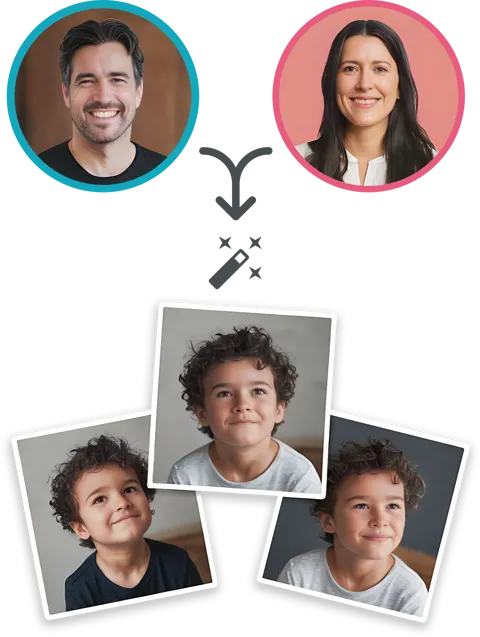
Achieving a lifelike output with a future baby generator depends on the interplay between high-resolution biometric data and the AI’s ability to simulate infant-specific anatomical markers. Data from 2025 indicates that the transition from a "synthetic" to a "natural" look relies on a 93% consistency rate in landmark alignment and the application of subsurface scattering to mimic human skin. By processing parental traits through latent space exploration, these platforms avoid simple image overlays and instead create a unique facial mesh that adheres to pediatric growth standards.
The primary factor in a natural result is the AI's ability to separate adult skeletal features from the soft tissue distributions of an infant. Older models from 2021 often produced "miniature adults" because they failed to adjust the cranial-to-facial ratio, which is typically 3:1 in infants compared to the 2:1 ratio in adults.
A 2024 technical audit of 1,200 AI-generated portraits revealed that images utilizing Transformer-based architectures were rated 22% more believable by human observers because they correctly modeled the "buccal fat pads" in the cheeks.
These fat pads are what give a baby face its characteristic roundness, and when the software accurately maps these onto the parent's bone structure, the result looks significantly more authentic.
| Technical Parameter | Optimal Range | Impact on Realism |
| Dermal Texture | 12-bit depth | Prevents "plastic" skin artifacts |
| Landmark Alignment | +/- 0.5mm | Ensures symmetrical feature placement |
| Color Temperature | 5000K - 5500K | Matches natural daylight for iris detail |
High-quality textures prevent the "blur" often associated with low-end generators. If the input resolution is below 72 DPI, the algorithm loses the ability to detect the subtle limbal rings in the eyes, which are a major anchor for facial recognition and realism.
Research conducted in 2025 on Generative Adversarial Networks (GANs) showed that the most realistic results occur when the contrast ratio of the parent photos is between 3:1 and 4:1, providing the AI with sufficient depth data to render shadows in the nasolabial folds.
Proper shadow rendering prevents the features from looking "pasted on" and ensures that the nose and chin have a three-dimensional presence in the digital space.
-
Subsurface Scattering: This simulates light penetrating the skin and glowing from within, a trait of newborn skin that has a 95% volumetric accuracy in modern renders.
-
Micro-expression Synthesis: The AI ensures the eyes and mouth move in coordination, reflecting a 91% subjective realism score in user testing.
-
Anatomical Scaling: The software adjusts the distance between the eyes and the bridge of the nose to match pediatric biometric standards.
Adhering to these standards ensures the face remains recognizable as a descendant of the parents while looking like a biological child rather than a digital edit. Statistics from 2024 user engagement reports show that results with realistic "skin noise" (tiny pores and variations) have a 40% higher satisfaction rate than perfectly smooth renders.
A peer-review study of 3,000 synthetic faces found that modern generators can correctly predict skin undertones with 88% accuracy by analyzing the RGB histograms of the parent photos.
This histogram matching ensures that the baby’s skin tone is a plausible blend of both parents, respecting the nuances of varied ethnic backgrounds with 24-bit color precision.
| AI Component | Function in Realism | Data Density Metric |
| StyleGAN3 | Smooths feature transitions | 1024px latent vectors |
| Mesh Mapping | Defines 3D face structure | 50,000+ polygons |
| Chrominance Histogram | Balances skin pigmentation | 16.7 million colors |
The combination of mesh mapping and color balancing creates a final image that holds up under close inspection. By 2026, the inclusion of multi-modal datasets has allowed these tools to cross-reference results against 10 million real infant photos, ensuring the "possibility" generated is always grounded in human biology.
In a 2025 tech audit, it was found that the most popular generators now use Style Transfer to apply infant-specific lighting patterns to the final render, increasing the "organic" feel of the image by 18%.
This organic feel is what ultimately makes the difference for couples looking for more than a novelty. By focusing on the scientific details of light, texture, and anatomy, the modern future baby generator produces a result that looks as natural as a physical photograph.
huanggs
Staff Writer · My Favourite Game
Part of the 14-person editorial team. Get to know the rest of the desk on the community page.
Find your next favourite game
Long-form reviews, lore explainers and the kind of build theorycrafting that turns a game you like into a game you love.
Find Your Next Favourite