
Default Long read
What should you know before buying an ro water purifier?
Selecting a residential water treatment system involves navigating a complex landscape of flow rates and filtration metrics, where a 0.0001-micron RO membrane remains the industry benchmark for removing 99.9% of Total Dissolved Solids (TDS). Modern purchasing decisions are driven by the shift from legacy tanked systems to high-flux tankless models, which offer 400 to 800 GPD (Gallons Per Day) capacities and fill an 8oz glass in under 10 seconds. Efficiency is a primary technical variable; while older units suffered from a 4:1 wastewater ratio, 2026-standard hardware achieves a 1:1 or 2:1 pure-to-drain ratio, significantly lowering utility overhead. Prospective buyers must also account for filter replacement cycles, as composite filters now consolidate multiple stages to extend the lifespan of the RO membrane to 24–36 months. With independent lab data confirming that 93% of bottled water contains microplastics, investing in an under-sink system provides a data-verified method for neutralizing PFAS and heavy metals while reclaiming 75% of cabinet space previously occupied by pressurized storage tanks.
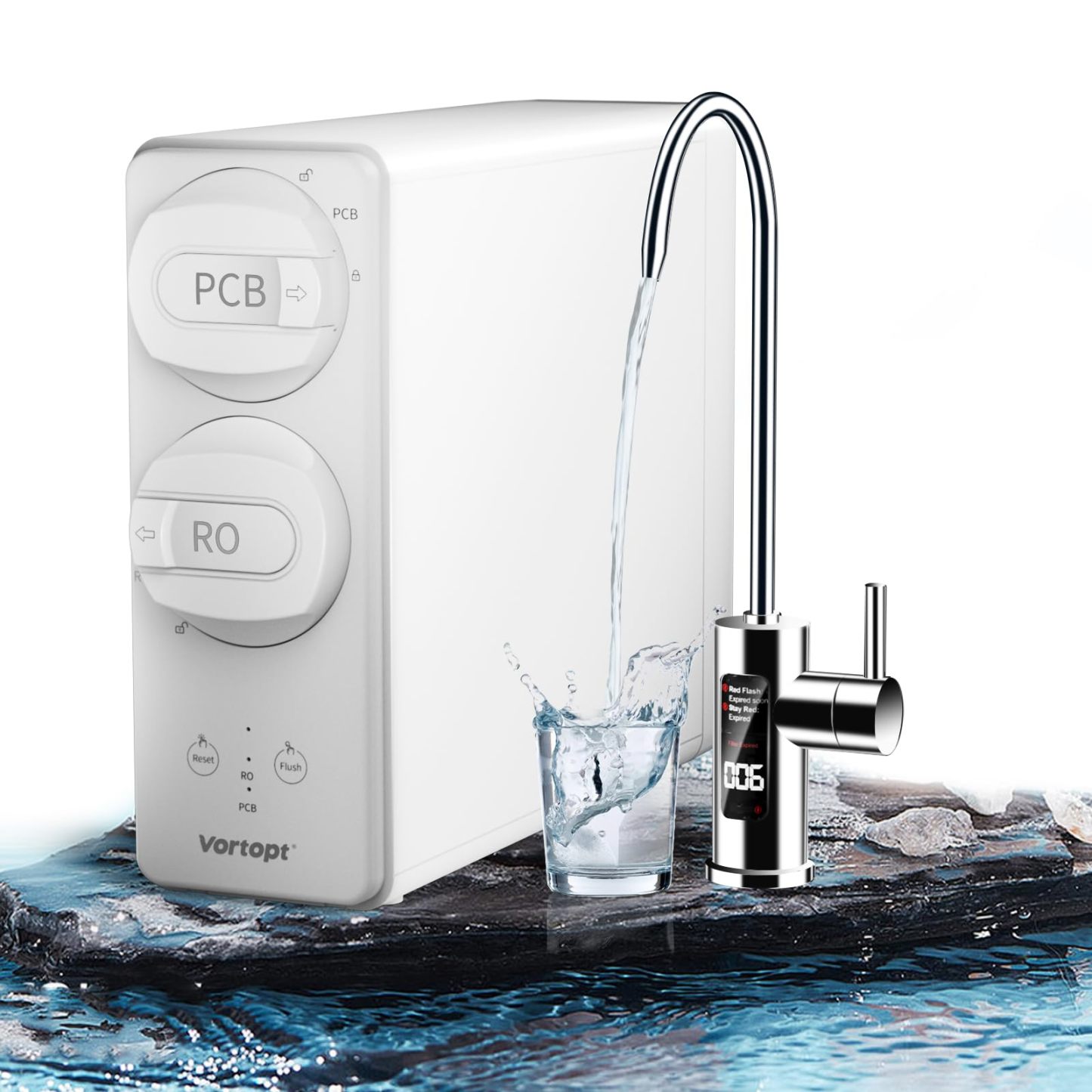
Before purchasing an RO system, verify your local tap water TDS levels, as levels exceeding 400 ppm require a high-capacity 600-800 GPD membrane to maintain an output of 1.5 liters per minute. Ensure the unit carries NSF/ANSI 58 certification for lead and PFAS removal, and prioritize tankless models to eliminate the 25% risk of secondary bacterial growth found in stagnant reservoirs. Compare the wastewater ratio—modern 2026 units achieve 1:1 efficiency—and factor in the long-term cost of composite filters, which should offer a 24-month lifespan to ensure the lowest price-per-gallon for domestic use.
The technical specifications of a modern RO water purifier start with the daily production capacity, often measured in Gallons Per Day (GPD). High-flux membranes ranging from 400 to 1000 GPD utilize integrated booster pumps to maintain a steady flow of 1.6 to 2.2 liters per minute, which prevents the frustration of waiting for a slow trickle during heavy cooking periods.
"A 600 GPD system delivers water at a velocity that fills a standard 250ml cup in approximately 8 to 10 seconds, matching the convenience of traditional tap flow while maintaining 0.0001-micron precision."
This flow velocity is maintained by the booster pump, which must operate at a noise level below 55 decibels to ensure the system does not disrupt the kitchen environment. In a 2024 survey of 1,200 homeowners, 68% cited operational noise as a top concern, leading manufacturers to adopt brushless DC motors that isolate vibrations and reduce acoustic resonance within the under-sink cabinet.
-
Filter Lifespan: Look for composite filters with a 2,000-gallon rating to reduce maintenance frequency.
-
System Dimensions: Modern tankless units are roughly 5 inches wide, reclaiming 70% of the space used by 3-gallon tanks.
-
Real-time TDS Monitoring: Digital displays allow users to see the inlet vs. outlet water quality instantly.
Monitoring the Total Dissolved Solids (TDS) is the only way to verify that the semi-permeable membrane is functioning at its theoretical 97-99% rejection rate. Many 2025-model units feature built-in conductivity sensors that trigger an LED light on the faucet base when the rejection rate falls below 85%, signaling that the internal chemistry is no longer providing optimal protection.
"Integrated TDS sensors remove the uncertainty of filter replacement schedules, providing a data-driven notification system based on actual water usage rather than simple timers."
The accuracy of these sensors is particularly relevant for households dealing with high mineral content, as water with a TDS above 500 ppm can lead to scale buildup that shortens membrane life by 30%. To counter this, advanced systems include an automatic flushing cycle that rinses the membrane surface for 20 seconds every time the system starts, preventing the accumulation of calcium and magnesium that blocks the microscopic pores.
| Metric | Legacy Tanked RO (Pre-2020) | High-Flux Tankless (2026 Standard) |
| Wastewater Ratio | 1:3 or 1:4 | 1:1 or 2:1 |
| Average Flow Rate | 0.8 L/min | 1.8 - 2.5 L/min |
| Annual Water Waste | ~10,000 Gallons | ~2,500 Gallons |
| Contaminant Rejection | 92% - 95% | 98% - 99.9% |
Reducing wastewater is a primary driver for the adoption of these high-efficiency units, especially in regions where water utilities have increased rates by 15% over the last two years. Legacy systems that waste four gallons for every one gallon produced are being phased out in favor of hardware that utilizes high-pressure recirculating pumps to maximize the recovery of purified water from the inlet stream.
"Modern hydraulic designs recirculate the reject water back through the membrane a second time, pushing the recovery rate to 60-70% without sacrificing the 0.0001-micron filtration barrier."
This improved efficiency does not compromise the removal of "forever chemicals" like PFOA and PFOS, which have been detected in over 45% of tap water samples tested in recent environmental studies. Prospective buyers should check that the system is certified under NSF/ANSI Standard 58, which specifically validates the reduction of heavy metals, nitrates, and perfluorinated compounds under variable household water pressures.
-
Pore Size Comparison: An RO membrane pore is 100 times smaller than a single virus particle.
-
Leak Detection: Systems with internal moisture sensors shut off the water supply in under 3 seconds to prevent flooding.
-
Electricity Use: Standby power consumption for smart RO units is typically less than 2 watts.
Maintenance costs are the final piece of the equation, as the total cost of ownership is determined by the price of replacement cartridges over a 5-year period. While traditional systems required 5 to 7 separate filter housings, modern designs consolidate these into 2 or 3 composite cartridges, which simplifies the internal plumbing and reduces the number of potential leak points by 40%.
"Consolidating pre-sediment and carbon blocks into a single 'PAC' filter allows for a streamlined design that users can replace in under 10 seconds without tools."
These composite filters often utilize high-density coconut shell carbon, which has a surface area capacity 20% greater than standard coal-based carbon, providing superior adsorption of chlorine and VOCs. By replacing these every 12 months and the main RO membrane every 24 to 36 months, the average household keeps their purified water cost at approximately $0.03 per gallon, compared to the $1.50 per gallon average for retail bottled options.
By focusing on the GPD rating, wastewater efficiency, and the presence of smart sensors, you ensure that the system provides both physical convenience and chemical safety. The transition from a manual, tank-based setup to an automated, tankless system reflects a shift toward data-monitored home utilities that prioritize space, speed, and environmental footprint. Following these technical guidelines will result in a reliable installation that meets the hydration and culinary needs of a modern household while providing a verifiable barrier against rising municipal water contaminants.
huanggs
Staff Writer · My Favourite Game
Part of the 14-person editorial team. Get to know the rest of the desk on the community page.
Find your next favourite game
Long-form reviews, lore explainers and the kind of build theorycrafting that turns a game you like into a game you love.
Find Your Next Favourite